Small Rooms, Big Nights: The Quiet Rise of Intimate Culture in Britain
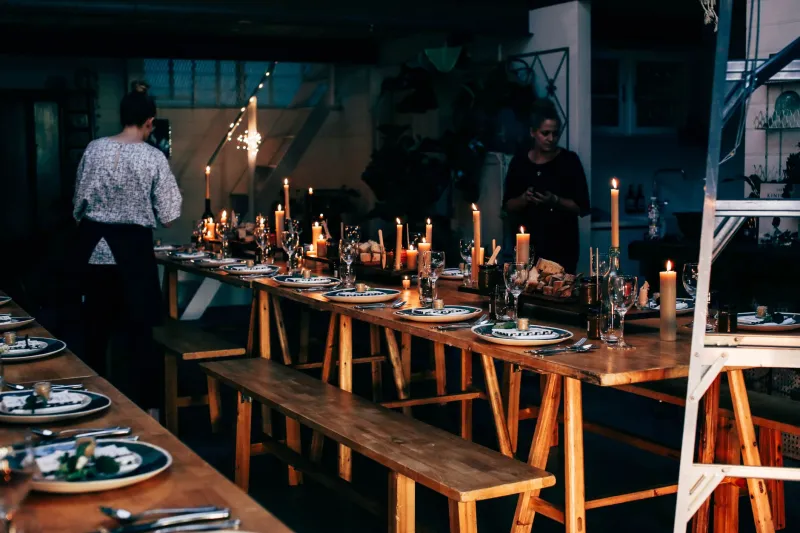
There is a particular kind of British night out that used to feel aspirational almost by default: the big venue, the expensive ticket, the queue that snakes around the block, the photographs that prove you were there. It still has its place. But in 2026, some of the most compelling cultural evenings are happening in rooms so small you can hear the ice settle in a glass. The appeal is not exclusivity for its own sake. It is the sense that something has been chosen, not simply sold.
Across London, Manchester, Bristol, Glasgow, Leeds, Edinburgh and Birmingham, the new cultural night is often a hybrid: part salon, part listening bar, part supper club, part bookshop gathering. A writer reads in a room above a pub. A DJ plays vinyl at a volume that allows conversation. A chef serves twenty people at a long table in a former textile studio. A bookseller hosts a launch with folding chairs and a table of wine. These are not fringe curiosities anymore. They are becoming the texture of a certain kind of city life.
The Appeal of the Almost-Private
The first thing to say is that intimacy is not the same as secrecy. The best small events are not trying to keep people out; they are trying to create the conditions for attention. When a room holds forty people rather than four hundred, the performer can take a risk. The audience can lean in. The evening can change shape depending on who is there. That is not a marketing gimmick. It is a different cultural form.
There is also a practical pleasure to it. You do not spend half the night in a queue. You are not shouting over a support act. You can hear the words. You can see the face of the person speaking. You might end up in a conversation with a stranger that lasts longer than the event itself. In a period when so much of our social life has been optimised for scale, smallness feels almost luxurious.
Why Smaller Feels More Aspirational
The old status symbol was access to the biggest room. The new one is access to the right small room. That shift says something about how British cultural life is changing. We are tired of being processed. We want to feel like guests rather than ticket holders. We want curation without condescension, and atmosphere without a dress code.
This is why the listening bar has become such a useful model. It borrows the seriousness of a concert hall and the sociability of a pub, but it asks you to do something unusual: listen. The same is true of salon-style talks, where an expert speaks for thirty minutes and then the room talks back. Supper clubs work on a similar logic. The meal is the event, but the seating plan is the social architecture. You are there to eat, but also to be among people who have chosen the same table.
None of this is entirely new, of course. Britain has a long history of private theatricals, literary salons, folk clubs and supper parties. What feels different now is the way these formats have become part of the mainstream cultural economy, rather than a charming side note. Independent bookshops have become event spaces. Restaurants have become listening rooms. Galleries have become dinner venues. The boundaries are softer, and the result is a more interesting night out.
The New Map of a Good Night Out
In London, the obvious examples are the listening bars of Hackney and Soho, the small supper clubs of Peckham and Dalston, and the bookshop events of Bloomsbury and Brixton. But the pattern is not London-only. Manchester has a strong tradition of independent venues and pop-up dinners; Bristol has a natural affinity for intimate music and food-led gatherings; Glasgow and Edinburgh have long understood the power of a small room. Leeds, Birmingham and Sheffield are full of promoters and booksellers doing interesting things with limited space.
The common thread is not a postcode. It is a certain attitude. The best small events are run by people who care about the details: the lighting, the seating, the length of the set, the temperature of the wine. They are not trying to create a scene. They are trying to create an evening. That distinction matters. A scene wants to be seen. An evening wants to be remembered.
How to Find the Good Ones
The good news is that these events are not as hidden as they sometimes like to appear. Start with the places you already trust: independent bookshops, small galleries, record shops, bakery-cafés, wine bars and local newsletters. Follow the venues rather than the influencers. Sign up to mailing lists. Read the noticeboards. Ask the person behind the counter what is happening next week. The best recommendations still travel by word of mouth, and that is part of the charm.
Be wary of anything that sells itself too hard on exclusivity. A small event that markets itself as a secret is usually just a big event with a smaller room. The genuine article tends to be more modest: a handwritten sign, a simple ticket link, a host who seems slightly surprised that people have come. Look for programme notes that tell you something about the thinking behind the night. Look for venues that have a clear point of view. Look for events that end at a reasonable hour and leave you with something to talk about.
The Etiquette of the Small Room
Small rooms have their own social contract. Arrive on time. Put your phone away. Do not treat the performer like background music. If there is a long table, talk to the person next to you. If there is a Q&A, ask a real question rather than a speech. Buy something if you can, because small events run on thin margins. And resist the urge to make the evening about your own access. The point of a curated night is not to prove you were in the know. It is to be present.
There is a fine line between intimacy and cliquishness, and the best hosts know it. They introduce people. They explain the format. They make room for newcomers without turning the evening into a networking event. If you feel like you have crashed a private club, the room is probably doing intimacy wrong. If you feel like you have been let in on something without having to perform, it is doing it right.
A Different Kind of Status
What makes these nights feel aspirational is not the price of the ticket or the difficulty of getting one. It is the quality of attention. In a big venue, you are part of a crowd. In a small room, you are part of an audience. That is a meaningful difference. It asks something of you, and it gives something back.
Britain in 2026 is not short of spectacle. What it sometimes lacks is texture: the low-lit, slightly imperfect, human-scale evening that makes a city feel liveable. The rise of the small cultural night is a correction to that. It is a way of saying that a good night out does not have to be loud to be significant. Sometimes the most memorable thing you can do is sit in a room with forty other people and listen.