Soup, Records and an Open Door: The Sunday Afternoon Britain Is Learning to Host Again
Photo: Evelyn Simak, CC BY-SA 2.0, via Wikimedia Commons
On a Sunday in November, the best invitation in Britain is not a booking at a restaurant with a six-week wait. It is a message that arrives at eleven: we are in from two, soup is on, come whenever. No RSVP. No dress code. No plan beyond the pot on the stove and a record that will be played twice because nobody can be bothered to turn it over.
The drop-in Sunday is having a moment. Not because we have suddenly become relaxed hosts, but because we have finally admitted that the dinner party is a lot of work for a short evening. The open-house afternoon is longer, softer and cheaper. It asks less of the host and more of the guest in one specific way: you have to be willing to arrive without a script.
The Case for the Unbooked Afternoon
The dinner party asks you to be a host. The drop-in Sunday asks you to be at home. That is the whole difference. A party has a beginning and an end; a standing invitation has a window. From two until five, or three until six. The window is the trick. It gives people permission to come for forty minutes or stay for three hours. It also protects you. You are not waiting for latecomers; you are simply in.
Sunday afternoon is the last unclaimed territory of the week. Saturday is for errands and Saturday night is for going out. Friday is for collapsing. Sunday morning belongs to the newspapers. But Sunday afternoon has a strange, open quality—too late for lunch, too early for supper, and somehow the most intimate hour of the week. Fill it with people and the whole week feels better.
The Etiquette of Coming and Going
For guests: bring something small or nothing. A bottle, a loaf, a bunch of flowers from the petrol station, a bag of oranges. Do not ask what to bring; ask if there is anything you can do. Arrive when you say you will. Leave when the pot is empty or when the conversation has naturally paused. Do not bring unannounced plus-ones unless you have asked. The standing invitation is generous, but it is not infinite.
For hosts: do not tidy endlessly. Accept help. Have one pot, one loaf and one thing to drink. Say the window clearly—we are in till five—and mean it. The door is open, not the floodgates. If someone offers to wash up, let them. If someone offers to bring dessert, say yes. The point is not to perform hospitality; the point is to make hospitality ordinary.
The best guests are the ones who treat the afternoon like a living room, not a restaurant. They put their coat on the bed. They take a bowl. They ask if they can put a record on. They leave without a long goodbye.
Styling a Room That Says Stay a While
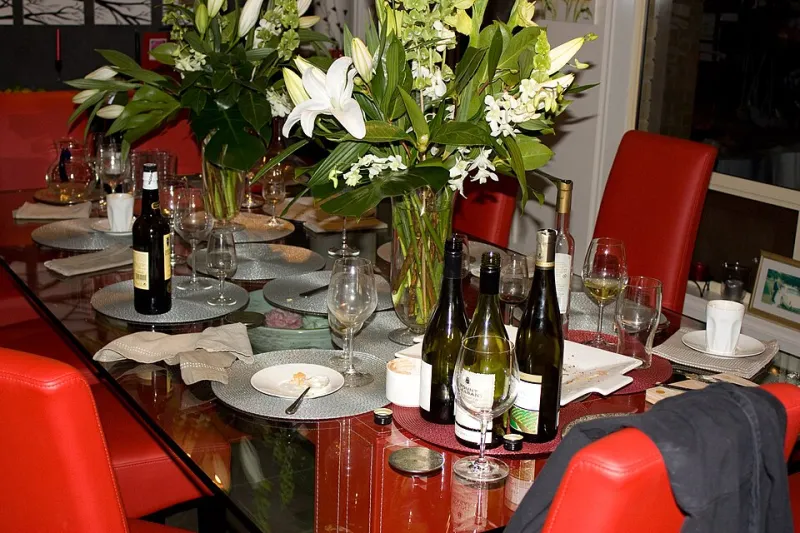
Styling a drop-in Sunday is not about tablescapes. It is about creating a landing pad. Clear the surfaces. Put out the good bowls. Light lamps, not the overhead. Put the record player on before anyone arrives, so the room has a voice. A pot of soup and a stack of bowls is the whole centrepiece. Add bread, cheese, apples, something pickled. Mismatched chairs are better than a matching set. A candle in the hallway is enough.
The house should look lived in, not staged. A drop-in Sunday is not the time for the fragile rug or the cushion that cannot be sat on. The best styling is a room that can absorb a spilled glass of wine and a child with muddy boots. Put the good things out. Use the linen napkins. Let the soup splatter. The room is not the point; the people in it are.
The Emotional Payoff
We are lonely for unplanned company. Not for a big night out, not for a dinner that requires three days of preparation, but for the simple knowledge that someone is at home and you can turn up. The standing invitation builds a map of people who know they can come in. It is a small network of belonging, and it costs almost nothing.
The soup is the excuse. The record is the excuse. The real thing is the hour of being together without a reservation. It is also a quiet rejection of the performance of hosting. The host is not a caterer. The guest is not an audience. Everyone is just in the room.
Start With One Pot
Choose a Sunday. Not the Sunday you have cleaned the house; the Sunday you have. Tell five people. Make a soup that can sit—leek and potato, ribollita, chicken broth with whatever is in the fridge. Buy two loaves. Put a record on. Do not wait for a bigger kitchen or a better sofa. The first Sunday will be small. That is fine. The second Sunday will be bigger, and someone will bring a friend, and by January you will have a ritual.
The standing invitation is not about being the most organised person in Britain. It is about being the person who is in. Soup on the stove. Record on. Door open. Come whenever.